
Why No-Till Gardening Changes Everything
Every spring, millions of gardeners do the same thing. They drag out the tiller, fire it up, and spend a weekend turning their soil into a freshly worked, sweet-smelling promise. Beds laid bare. Ground broken. The season, officially begun. Leaving nothing for no-till gardening.
It feels productive. It feels right. And feels like what a serious gardener does.
It is, according to a growing body of soil science, one of the most destructive things you can do to your garden.
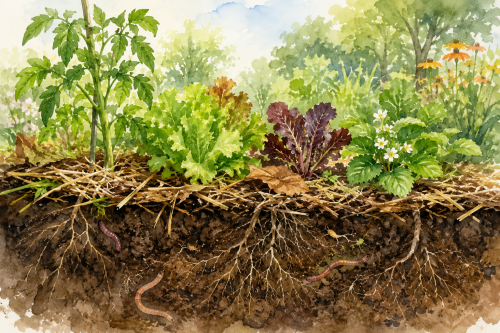
The soil beneath your feet is not empty. It is one of the most complex ecosystems on Earth, and conventional tilling has been quietly wrecking it for decades.
This is not a fringe theory. It is backed by university research, championed by leading horticultural institutions, and quietly adopted by thousands of home gardeners who noticed something strange after they stopped digging: their plants grew better.
Welcome to the no-till revolution.
Why tilling feels productive – but isn’t
The logic behind tilling seems airtight. Loose soil lets roots spread. Turning the earth buries weeds. Aerating creates drainage. For generations, this was considered basic gardening competence.
There is just one problem: soil is not a passive medium waiting to be improved by a spade. It is alive.
In a single teaspoon of healthy garden soil, there are more microorganisms than there are people on Earth. Fungi, bacteria, protozoa, nematodes, they form a web of invisible life that processes nutrients, fights disease, and quite literally feeds your plants.
At the centre of this web are mycorrhizal fungi: thread-like networks that extend a plant’s root system by up to 700 times its natural reach. These networks connect plants, transfer nutrients, and carry water in dry conditions. Scientists now call this the ‘Wood Wide Web’, and it is destroyed completely by the blade of a tiller.
Here is the brutal truth: when you till, you are not preparing your soil. You are starting over from scratch, killing the very community that makes your garden work. The temporary boost you see, loose, dark, seemingly fertile soil, is the result of a mass decomposition event. Dead microbes releasing their nutrients all at once. A short-lived windfall followed by a long decline.
Quick fact: Research from the Rodale Institute shows no-till plots consistently outperform tilled plots in long-term yield, weed suppression, and drought resistance after the first two to three seasons.
No-till is not no-effort, it is smart effort
So what is no-till gardening, exactly?
The principle is elegantly simple: instead of turning the soil, you build on top of it. You layer organic matter, compost, straw, leaf litter, cardboard, on the soil surface and let the ecosystem below do the work of incorporating it. No digging required. Zero back pain. No weed seed bank churned to the surface.
The most beginner-friendly version of this approach is called the lasagna method (also known as sheet mulching). Just like the pasta dish, it works in layers:
- A base layer of cardboard smothers existing weeds and grass
- Compost, aged manure, or topsoil goes on top
- A thick mulch layer of straw, wood chips, or leaves finishes it off
Over weeks and months, worms pull the cardboard apart. Fungi colonise the layers. The whole stack slowly integrates into rich, aerated, living soil, without a single turn of the spade.
Critics often dismiss this as lazy gardening. It is the opposite. No-till requires you to think in years, not weekends. You are not managing your soil for this season; you are building it for the next decade.
Underground, there is a world you have been destroying
To truly understand no-till, you need to think about what happens below the surface, specifically in the top 6 inches of soil, which ecologists call the rhizosphere.
This zone is the most biologically active environment on land. A gram of healthy rhizosphere soil can contain:
- Up to 1 billion bacteria from around 10,000 different species
- Hundreds of metres of fungal threads (hyphae) per teaspoon
- Dozens of species of nematodes and protozoa
- Earthworms whose tunnels aerate the soil better than any mechanical tool
Each of these organisms plays a role in a nutrient cycle that has operated, without human interference, for 450 million years. Fungi dissolve minerals from rock and trade them with plant roots in exchange for sugar. Bacteria fix atmospheric nitrogen directly into the soil. Earthworms process organic matter and excrete nutrient-dense castings.
When you till, you shatter this entire structure. You expose anaerobic soil bacteria to oxygen, killing them instantly. Damaging fungal networks that took years to establish. You bring dormant weed seeds to the surface, where they promptly germinate. And you eliminate the tunnel architecture that gives your soil its structure, leaving it prone to compaction as soon as the first rain falls.
Tilling your soil is like bulldozing a city so you can build a single road. The short-term result looks like progress. The long-term cost is staggering.
No-till protects this ecosystem. Left undisturbed, the soil builds on itself, becoming progressively richer, more water-retentive, and more biologically diverse with each passing season.
Your first no-till bed in one afternoon
The good news: switching to no-till requires no special equipment, no expensive inputs, and about an afternoon of your time. Here is a complete beginner’s setup using the lasagna method.
What you will need:
- Cardboard boxes (free from any supermarket or hardware store), remove all tape and staples
- Compost – homemade, bagged, or a mix of both
- Straw, wood chips, or shredded autumn leaves for mulch
- A garden hose
Step by step:
- Mow or cut down existing grass and weeds as low as possible. Do not dig them out, you want the roots to decompose in place.
- Lay cardboard directly over the area, overlapping the edges by at least 15 cm so weeds cannot sneak through the gaps. Water it thoroughly until it is fully saturated.
- Spread a layer of compost 8 to 10 cm thick directly over the wet cardboard. This is the primary growing medium for your first season.
- Top with 5 to 8 cm of straw or wood chip mulch. This locks in moisture, regulates soil temperature, and continues feeding the soil as it breaks down.
- Water the whole stack well. Then wait two to four weeks before planting, to allow the cardboard to begin softening.
- To plant, simply push aside the mulch, make a small hole through the compost layer, and plant directly into it. For seeds, create a shallow furrow in the compost and cover lightly.
- Each subsequent season, top-dress with 3 to 5 cm of fresh compost. No digging. No turning. Let the worms do the rest.
Pro tip: If you want to use the bed immediately without waiting, skip the cardboard and use a thicker compost layer (15 cm+). The weeds will be suppressed, and you can plant right away.
Answers to every excuse not to try this
The no-till gardening method has been around for decades, yet many gardeners resist it. Here are the most common objections, and why they do not hold up.
“My soil is too compacted, I have to break it up.”
Compaction is usually caused by foot traffic and, ironically, by tilling. Each pass of a tiller creates a hardpan layer just below the tine depth that water cannot penetrate. The lasagna method builds new growing space on top of the compacted layer and slowly breaks it down from above via root activity, earthworms, and moisture cycling. Within two seasons, most compacted soils show significant improvement.
“Weeds will take over without tilling to bury them.”
This is exactly backwards. Tilling brings dormant weed seeds from deep in the soil bank up to the germination zone. Research consistently shows that no-till beds have significantly fewer weed problems over time, not more. The cardboard starting layer and thick mulch suppress weed germination without disturbing the soil.
“It will not work for vegetables, they need loose, deep soil.”
Thousands of market gardeners and home growers run productive vegetable beds using no-till. Root vegetables like carrots and parsnips do better in undisturbed soil with established worm channels than in freshly tilled, structureless ground. The key is building enough compost depth in the initial setup.
“The results take too long.”
The first season is the adjustment period. By season two, most gardeners report healthier plants, dramatically fewer weeds, better moisture retention, and notably less work. The investment of one afternoon upfront pays dividends for years.
What real gardeners are seeing
The numbers behind the no-till movement are striking. A 2026 gardening outlook study found that sustainability has become less of a talking point and more of a baseline for modern gardeners. Shaping how they choose methods, design beds, and care for their soil over the long term.
Online gardening communities tell a similar story. In forums and social groups, converted no-till gardeners consistently describe the same arc: scepticism in year one, visible improvement in year two, and near-evangelical enthusiasm by year three.
I tilled every spring for fifteen years. I stopped two years ago on a whim. And will never go back. My beds practically garden themselves now.
From a 2025 University of Minnesota Extension report, using no-till gardening methods in challenging clay soils reported better moisture retention, fewer weeds, and improved plant health across vegetables and perennials alike, outcomes that tilling had consistently failed to deliver in the same plots.
The pattern repeats across climates, soil types, and garden sizes. Once you stop fighting the soil and start working with it, the results speak for themselves.
Your soil wants to help you. Let it.
Here is the most important thing to understand about no-till gardening: the soil beneath your feet has been doing this job for millions of years without your intervention. It knows how to grow things. It knows how to process nutrients, manage water, and fight disease.
Every time you till, you interrupt that process. Every time you leave it alone and simply feed it from above, it rewards you.
This spring, instead of reaching for the tiller, try something different. Lay some cardboard. Pile on the compost. Step back. Watch what happens. Use Kunapajala fertilizer.
Your back will thank you. Your plants will thank you. And the billion organisms living quietly beneath your feet, the ones who have been doing all the real work this whole time, will finally get the chance they deserve.
Ready to try no-till?
Share this article with a gardening friend, save it for this weekend’s project, or drop a comment below telling us about your soil story. We read every one.
Leave a Reply